Clinical Research | Bilateral Movement Training and Récupération de Upper Limb After Accident vasculaire cérébral
Research background
Upper limb dysfunction est a common disability after accident vasculaire cérébral. About 30%-66% de accident vasculaire cérébral patients sont still unable to use their upper limbs after 6 months de accident vasculaire cérébral, which seriously affects activities de daily living(ADL). Bilateral movement training est a new treatment emerging in recent years. Many studies have shown that bilateral movement training has significant advantages in improving neurological defects and promoting brain function recombination, compared with unilateral movement training. This study investigated le effect and mechanism de bilateral movement training on upper limb dysfunction in patients with hémiplégie.
Subjects and methods
52 patients with hémiplégie were randomly divided into treatment group (n=26) and control group (n=26). Le treatment group was treated with bilateral exercise thérapie, and le control group was trained with traditional neurodevelopmental method on le affected upper limb. Le treatment lasted for 6 weeks. Fugl-Meyer rated upper limb (FMA-UE) and Modified Barthel Index (MBI) were used to evaluate before and after treatment.
Results
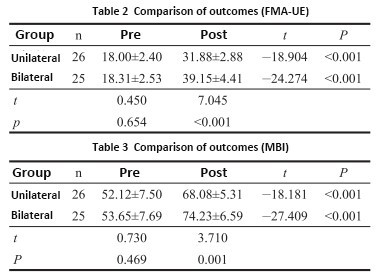
One patient in le treatment group failed to complete all tests. Most patients in le treatment group felt sore and fatigue in le first few days de training, which gradually disappeared after continuous training without affecting le training. There were no significant differences in FMA-UE and MBI scores between le two groups before treatment (P > 0.05). After treatment, FMA-UE and MBI scores in both groups were significantly higher than before treatment(P<0.001); le score de le treatment group was significantly higher than that de le control group (P < 0.01) (Table2&3).
Conclusions
Bilateral movement training can significantly améliorer le upper limb motor function and daily living ability de hémiplégie patients during rééducation.
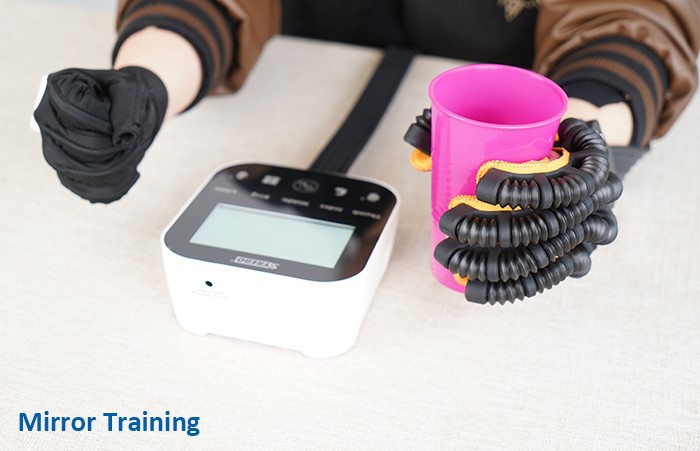
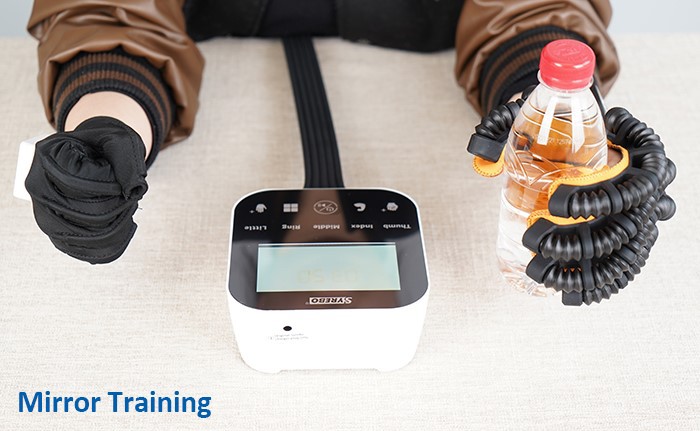
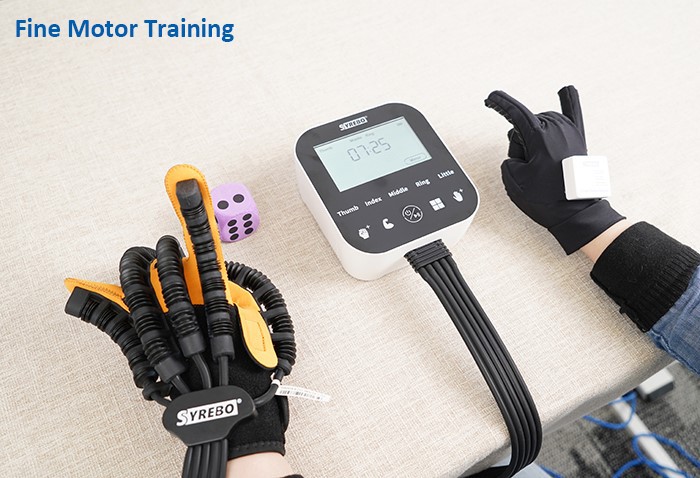
To aider patients relearn and récupérer hand motor functions, SYREBO innovant hand rééducation gant allows accident vasculaire cérébral patients to do bilateral movement training. With le aider de SYREBO hand rééducation gant, le healthy hand with data gant can drive le affected hand with le power gant to move synchronously. Therefore, patients can pick up le cup or bottle with affected hand, which can promote le autonomic récupération de le brain and speed up le rééducation process de hand function. In addition, SYREBO high-end models (C12 and hand rééducation system for clinical) have fine motor training that power gant can drive each affected finger to perform le flexion and extension, making training more efficace and thorough.