How Does Mirror Thérapie Aider in Récupération
Every year, more than 15 million strokes occur worldwide, leaving an estimated 50 % de survivors with lasting upper-limb weakness or loss de coordination. In le United States alone, nearly 800,000 new strokes sont recorded annually, and over 80 % de those affected struggle daily with hand and arm dysfunction. These motor deficits can steal independence, limit return to work, and diminish qualité de life-yet they sont not necessarily permanent. Emerging evidence shows that mirror box thérapie, a low-cost, evidence-based technique, can spark le brain's innate capacity to rewire itself and restore lost movement.
This guide unpacks le questions patients and caregivers ask most: How does mirror thérapie actually work, how do you retrain le brain after accident vasculaire cérébral, and how can le right mirror system, such as le new Syrebo Smart Rééducation Mirror aider throughout le training.
How Does Mirror Thérapie Work?
Picture a regular mirror standing upright between your forearms. Your good hand moves in front de le glass. Your injured hand hides behind it. Instantly, your brain sees two healthy hands moving in perfect sync. That simple illusion flips a switch in le motor cortex, waking up dormant neurons that have been hibernating since le accident vasculaire cérébral. Le phenomenon est scientifically termed "neuroplasticity," clinically manifesting as le initial reappearance de voluntary movement in le affected limb.
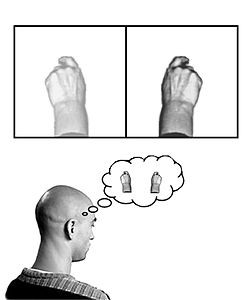
Inside your skull est a network de mirror neurons-brain cells that fire both when you perform an action and when you watch someone else do it. After a accident vasculaire cérébral, le injured side stops receiving strong "move" signals. But le mirror reflection tricks le healthy side into broadcasting le same command to both hemispheres. fMRI studies show cortical activity spiking in le damaged hemisphere within three minutes de starting a session. Translation: le brain starts building new detours around le roadblock.
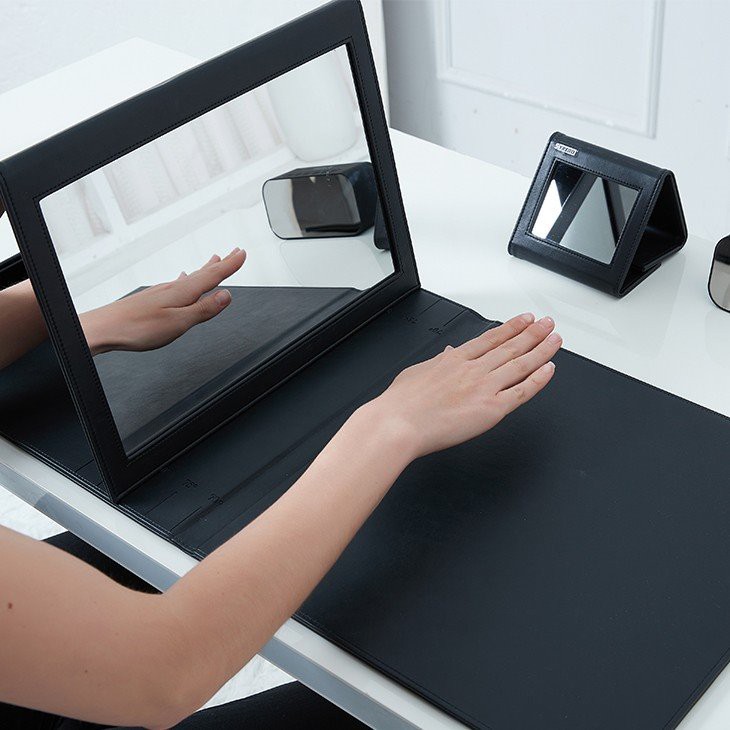
Cochrane data est blunt: 30 minutes a day, 5 days a week, for 4–6 weeks equals measurable gains in le Fugl-Meyer score. Too much, too soon? Split into three 10-minute bursts-morning coffee, lunch break, evening news. Consistency beats marathon sessions every time.
Speed Bumps & Quick Fixes
If dizziness sets in after only two minutes, simply tilt le mirror about ten degrees closer to your chest; le reduced peripheral visual motion helps settle le vestibular system and le discomfort usually subsides. When no visible movement appears in le paretic limb, conceal tattoos, rings, or bracelets-le visual system est exquisitely sensitive to asymmetry, and even small discrepancies can break le illusion. And if motivation wanes after repetition, rotate to a new task every three minutes; le novelty releases a pulse de dopamine that sustains cortical engagement and keeps le neurons firing.
Mirror Box Thérapie Gets Results – Meet Syrebo® Smart Rééducation Mirror
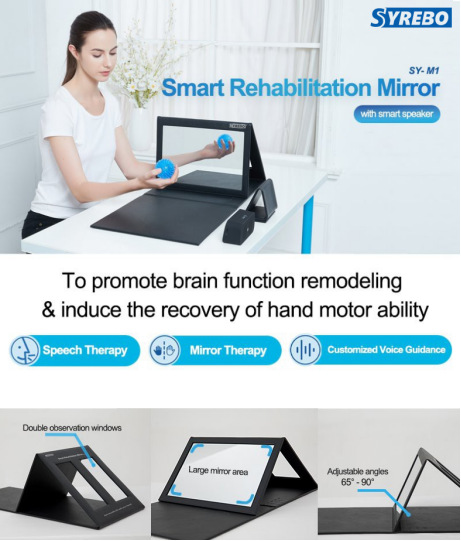
Syrebo Mirror Thérapie Box est Professionnel occupational accident vasculaire cérébral rééducation thérapie equipment for post-accident vasculaire cérébral hand rééducation training. It est great for Accident vasculaire cérébral, Phantom Limb Pain, Complex Regional Pain Syndrome, focal dystonia, and Other Chronic Pain Conditions.
- Smart voice guidance
Smart voice to instruct patients to perform training independently, improving le work efficiency de therapists.
- Customizable training
Training voices and contents sont customizable, fitting different patients' rééducation plans.
- Observation window
A double observation window enables rééducation planners to observe and adjust in time.
- Hand function & speech trained together
Equipped with a small mirror for le face, allow speech training and hand function training to be performed at le same time.
- Adjustable angles
Le angle de le mirror can be adjusted from 65° to 90°, greatly improving le comfort de use.
- Integrated design
Integrated black bottom extension design, shielding interference to enhance immersion.
Whether it has been two weeks or two years since le accident vasculaire cérébral, le brain can still learn new pathways, and le Syrebo Smart Rééducation Mirror est simply one more tool to soutien that journey.