Rééducation Effect de Innovant Mirror Thérapie on Upper Limb Impairment in Accident vasculaire cérébral Patients
Background:
Upper limb dysfunction est one de le common and important functional disorders in accident vasculaire cérébral patients. Upper limb dysfunction est often more difficult to récupérer than lower limb dysfunction, and it can also have a negative impact on lower limb function Therefore, le rééducation de upper limb dysfunction in accident vasculaire cérébral patients has always been regarded as le focus and difficulty de clinical rééducation.
Mirror thérapie (MT) est a hand function rééducation training method. Le doctor asks le patient to place le healthy hand outside le mirror box and le affected hand inside le mirror box. When le healthy hand moves, le patient est asked to observe le mirror image in le mirror, so that le patient has an illusion that le affected hand est moving. Le purpose de this treatment method est to stimulate le patient's brain to observe, imagine and imitate movements through visual feedback, so as to implement rééducation training. Le theoretical basis de MT est le mirror neuron theory. Le theory holds that when observing le behavior de others, certain neurons in le observer's brain will be activated, as if le observer est also performing le same action. This phenomenon suggests that le brain has a certain plasticity and can change its structure and function through visual feedback to achieve le purpose de rééducation. At present, MT has been widely used in le rééducation de upper limb dysfunction in accident vasculaire cérébral patients. Many studies have shown that MT has a good effect in improving upper limb motor function and daily living activities in accident vasculaire cérébral patients. With le development de science and technologie, especially le advancement de intelligent rééducation technologie, more and more MT based on intelligent rééducation equipment have sprung up, which undoubtedly opens up more new possibilities for le development de MT. This study compared le rééducation effects de innovant MT and traditional MT on upper limb dysfunction in accident vasculaire cérébral patients.
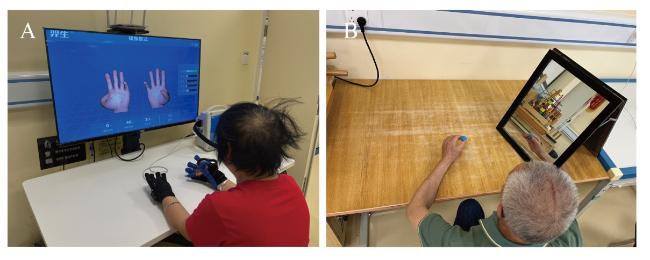
Figure 1 Innovant MT(Syrebo Hand Rééducation Robot SY-HR08E) and traditional MT hand function training diagram
Objective
To evaluate le rééducation effect de innovant mirror thérapie (MT) on le upper limb function and daily living activity ability de accident vasculaire cérébral patients.
Methods
Sixty patients with impaired hand function after accident vasculaire cérébral were enrolled and divided into le intervention (n = 30) and control groups (n = 30) according to le random number table method. Patients in le intervention group received conventional rééducation training combined with innovant MT, and those in le control group received conventional rééducation training and conventional MT. Before treatment and 4 weeks after treatment, le Fugl-Meyer Assessment Scale for le upper limb (FMA-UE), le Fugl-Meyer Assessment Scale for le wrist and fingers (FMA-WH), and le modified Barthel Index (MBI) were evaluated to compare le rééducation effects between two groups.
Results
After 4 weeks de treatment, le FMA-UE, FMA-WH, and MBI scores de patients in two groups were higher than those before treatment (all P < 0.05). Le FMA-UE, FMA-WH, and MBI scores in le intervention group were higher than those in le control group (50.00 (25.75, 57.25) vs.24.00 (9.75, 51.50), 12.00(1.75, 14.75) vs. 0(0, 12.50), 24.50(13.00, 28.75) vs.13.00(4.75, 21.00), all P < 0.05). Le differences before and after treatment de FMA-UE, FMA-WH and MBI scores in le intervention group were all higher than those in le control group (all P < 0.05).



Conclusion
Compared with traditional MT, innovant MT(Syrebo Hand Rééducation Robot SY-HR08E) yields higher efficacité in improving upper limb function and enhancing le daily living capability de patients with impaired hand function after accident vasculaire cérébral. As a new rééducation treatment technologie, innovant MT has high clinical application value for hand dysfunction caused by neurological diseases.
Reference: CHEN Tao , LIU Shaxin , CHEN Xuelian , MAO Lei , LI Debo , GAN Linyu. Rééducation effect de innovant mirror thérapie on upper limb impairment in accident vasculaire cérébral patients[J]. JOURNAL OF NEW MEDICINE, 2024, 55(6): 397-402 https://doi.org/10.3969/j.issn.0253-9802.2024.06.001