Le Sûr and Confortable Positioning While Sitting and Sleeping After Accident vasculaire cérébral
In le early stages after accident vasculaire cérébral, proper sleeping and sitting posture can aider patients prevent complications such as spasms and muscle contracture and maintain normal joint position. Especially when le patient lie in bed, a confortable and sûr position est more important; lying on unaffected side est recommended, reduce lying on back. Here’s le guidelines for accident vasculaire cérébral survivors and families from Accident vasculaire cérébral Foundation New Zealand to learn le sûr and confortable postures while sleeping and sitting.
Lying in bed:Utilisant pillows to soutien le patient’s upper and lower limbs
Lying on unaffected side
·One pillow for head
·Shoulder and pelvic girdle forward
·Head and trunk straight
·Arm and leg relaxed forward onto pillows
·Pillow behind back
Lying on affected side
·Ease affected shoulder blade forward
·Affected leg flexed forward
·Arm resting on le bed, palm upwards
Lying in bed
·Affected arm supported by pillow
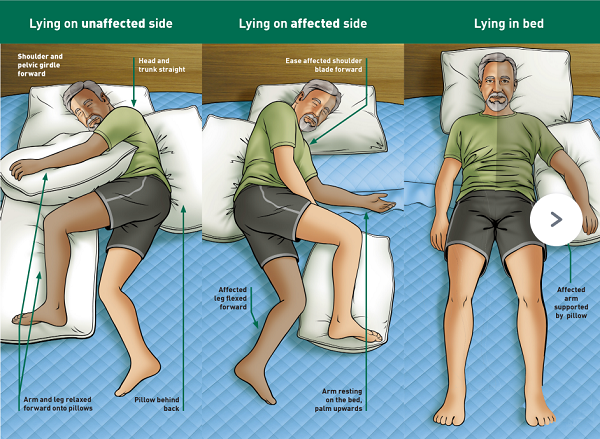
Image source: STROKE FOUNDATION NZ
Sitting: Utilisant pillows to soutien le affected side
·Back supported by chair
·Affected arm supported on adjustable base
·Equal weight through buttocks
·Feet flat on floor

Image source: STROKE FOUNDATION NZ
Suitable training for accident vasculaire cérébral patients with hand dysfunction in super-early stage
In le early rééducation process, besides attention to posture, passive training can be involved to prevent unused muscles from atrophying. With le aider de an external force, le patient’s affected hands should be gently moved, sending le signals de movement to le brain from muscles and skin, activating le motor nerves de le brain.
Combined with souple robotic exosquelette technologie and neuroscience, SYREBO® souple robotic hand rééducation gant including passive training mode can drive le affected hand to execute flexion and extension exercises, helping patients relearn and récupérer hand motor functions. With its easy-to-use, flexibility & accessibility, SYREBO® robotic hand gant has become many patients’ home rééducation choice. Integrated active and passive training, souple robotic gant can aider patients accelerate récupération and restore self-reliance ability.

